February 18, 2025
The Necessity of Reflective Practice for Coaches
By Ken Giglio, Principal of Mindful Leadership
Without reflection coaches miss turning their experiences with clients into learning and growth. They also miss the opportunity, and, in my view, responsibility, for modeling for the leaders they coach what reflection looks and feels like. Leaders in our current environment are dealing with levels of complexity never before seen in the modern era as AI strategies quicken what was already a breakneck speed of change.
What these leaders are hungry for is a pause in the action to collect their thoughts and reflect on what just happened and is happening now before being swept back up by the urgency of the day. Coaches can slow things down with questions that help leaders step back into an observer mode versus simply staying in action mode.
Coaches are also in need of reflection, and an increasing number are consistently using reflective practice by working 1:1 or in groups with qualified coach supervisors to fortify their coaching work.
Investing in a reflective practice is not “nice to have,” it is the ground from which effective leadership grows. As the organizational consultant Margaret Wheatly notes, “Without reflection, we go blindly on our way creating more unintended consequences and failing to achieve anything useful.”
What is reflective practice?
Here is an adapted definition from Donald Schon’s book The Reflective Practitioner: How Professionals Think in Action.
Reflective practice is a critical and deliberate inquiry into professional practice in order to gain a deeper understanding of oneself, others, systems, and the meaning shared among individuals. This inquiry can happen during practice/work (mindful in action) and after the fact (on action) and can be done alone or with others.
We reflect to learn from experience; we learn to adapt and change for the betterment of ourselves, others, and organizations.
As executives need to reflect more and react less to meet the challenges of these times, so do the coaches who support them. As coaches (I use the term broadly to include internal coaches, HRBPs, and external coaches), we need to polish our own mirror to be “fit for practice” in our work with leaders and their organizations.
Supervision has become the key vehicle for reflective practice for coaching professionals. Coaches engaging in all the various coaching modalities—one-on-one, team, and group—have benefited from reflecting on all aspects of their coaching practices through the lenses of their relationships with themselves, their clients, and the systems in which they do their coaching.
Group and team coaches more especially, from my experience, find safe havens in reflective practice with other coaches (aka group supervision). Reflective practice groups create an environment where coaches can share challenges from their work freely and learn from each other’s experiences with clients. I often hear from the groups I lead that coaches also feel more settled and confident after reflecting together with their coach colleagues. They know and feel they are not alone.
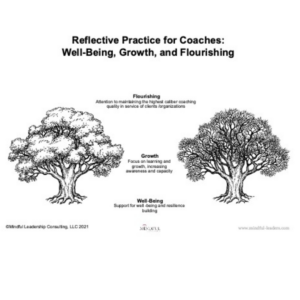
Here are the three reasons to invest in a reflective practice (one-on-one or in groups), which are also historically called the “functions” of supervision:
-
- Well-Being – coach well-being and resilience building
- Learning and Growth– coach competence and capacity building
- Flourishing (Qualitative) – coach quality control, including contracting and ethics
Well-Being
In general, and especially in our current challenging environment, it is emotional support a coach needs most from reflective practice. In a group supervision session I led during the pandemic one coach presented a challenging client case. As the group and I listened, the coach expressed doubts about their approach; the coach questioned if they were “good enough” for this client. In addition, the coach was also fatigued from their home-schooling role as a parent.
Feelings of being depleted and overwhelmed due to Covid stressors were overshadowing the coaching work. The supervision dialogue and reflection shifted to support the coach’s present experience with the group providing empathy, understanding, and emotional support. The group acknowledged and normalized the coach’s experience as we were all feeling exhausted to some extent with all that life had thrown our way.
To better engage with their clients, the coach needed to devote more attention to their well-being so they could tap into and reinforce a resilient mindset and behaviors. The coach became aware they needed to practice self-compassion to mitigate their self-judgment. They ended with “I am a good enough and also tired coach.”
A coach’s well-being and resilience is the ground from which all good work happens, because well-being leads to well-doing.
Learning and Growth
Generally, coaches know their learning is not done when they graduate from a coach training program. We know developing our coaching competence, confidence, and capacity requires practice and continuous learning. As we reflect on coaching cases in supervision, we follow the advice of the poet Walt Whitman, to “be curious and not judgmental.”
One area I am always curious about in my coaching practice and the practices of my supervisees is the influence of our self-stories. These stories (or scripts) originate in our childhood, and we all carry them forward in our coaching work in different ways. For example, one coach realized they were enacting parental behaviors with a client by being overly protective–unconsciously treating the client like a child. A supervision conversation helped the coach stay aware of keeping the coaching conversations adult-to-adult and to begin to unlearn their parent/child relational pattern with clients. Reflection helps us become more conscious in the moment so we can steer clear of our conditioned patterns from our past.
A coach’s commitment to their continuous learning keeps them on a developmental edge, always deepening and widening their competence and capacity and unlocking potential.
Flourishing (Qualitative)
Flourishing for coaches means being mindful of their presence while leveraging all aspects of their practice to foster continuous growth for clients and themselves. The integrity of a coach’s work depends on delivering the highest quality coaching to their clients and organizations. Quality control is essential and encompasses how we contract with clients and organizations and how we establish professional boundaries as well as ethical standards.
In one of my supervision cases, an internal coach/HR Business Partner was struggling to navigate the escalating tensions between their senior vice president business partner and vice president from another division. The vice president was supported by a different HR Business Partner, a colleague of my supervisee. The trouble here was the Business Partners also had a difficult relationship, which compounded, rather than alleviated, the escalating tensions.
Complications can arise for internal coaches (as with the two above) because they work within the corporate system they are coaching in, which means swimming in the same waters where the coach and coaching client know the same people and experience the same company politics.
In our supervision conversation, we explored the initial coaching contract and reflected together on when to know how to push back and challenge the executives they supported and when to let go. We also looked at how the tensions between the senior executives might be paralleled, or played out, between the HRB’s and its impact on their coaching work.
Supervision research suggests supervisors find half of the issues brought to them by coaches are related to original contracting, and this case supported the findings. In the end, the insight from reflective practice was to revisit the original contracting with the executives and HBP colleague and re-contract and restructure the coaching work accordingly.
As the coaching field grows, so does the need for mindful reflective practice, aka supervision. Leaders are not reflecting enough, especially during these trying times. They are not learning at the pace they need to so they can keep up with the changes in the business environment. It is our job as coaches to model a reflective approach. The emerging research shows coaches who attend to their well-being, continuously develop their competence and capacity, and focus on quality control are the coaches most fit for purpose.